Diagnosing Battery Sag in Drone Flight Logs: A Comprehensive Guide
drone technologybattery managementflight logsLiPo batteries

Diagnosing Battery Sag in Drone Flight Logs: A Comprehensive Guide

LogHat AIMarch 24, 202617 min read

Key Takeaway

Battery sag diagnosis helps detect LiPo battery issues in drone flight logs.

Introduction

Battery sag is the primary cause of unexplained flight instability in drones, yet most operators don't discover degraded cells until after a crash or unexpected landing. Voltage sag—the temporary drop in battery voltage under load—directly impacts motor performance, can trigger EKF (Extended Kalman Filter) resets, and in severe cases, causes complete loss of control authority. Understanding how to diagnose battery sag through flight log analysis is essential for any operator running multi-mission operations or managing fleet battery health.

LiPo and Li-ion batteries degrade with every charge cycle, but the degradation isn't linear. A battery that performed flawlessly for 50 flights can suddenly exhibit dangerous voltage sag on flight 51. The challenge isn't just knowing when to retire a battery—it's catching the early warning signs before they compromise safety. This guide will teach you to read voltage behavior patterns in ArduPilot and PX4 logs, correlate throttle demand with voltage response, and establish data-driven retirement criteria for your battery fleet.

You'll learn to interpret specific log parameters like BATT.Volt, RCIN.C3 (throttle), and BATT.Curr, understand what constitutes healthy versus dangerous sag thresholds, and implement a systematic monitoring process that catches degraded cells before they affect operations. LogHat surfaces these critical voltage-throttle correlations automatically, flagging batteries that exhibit abnormal sag patterns so you can make informed replacement decisions based on actual performance data rather than arbitrary cycle counts.

Understanding Battery Sag: What Happens Under Load

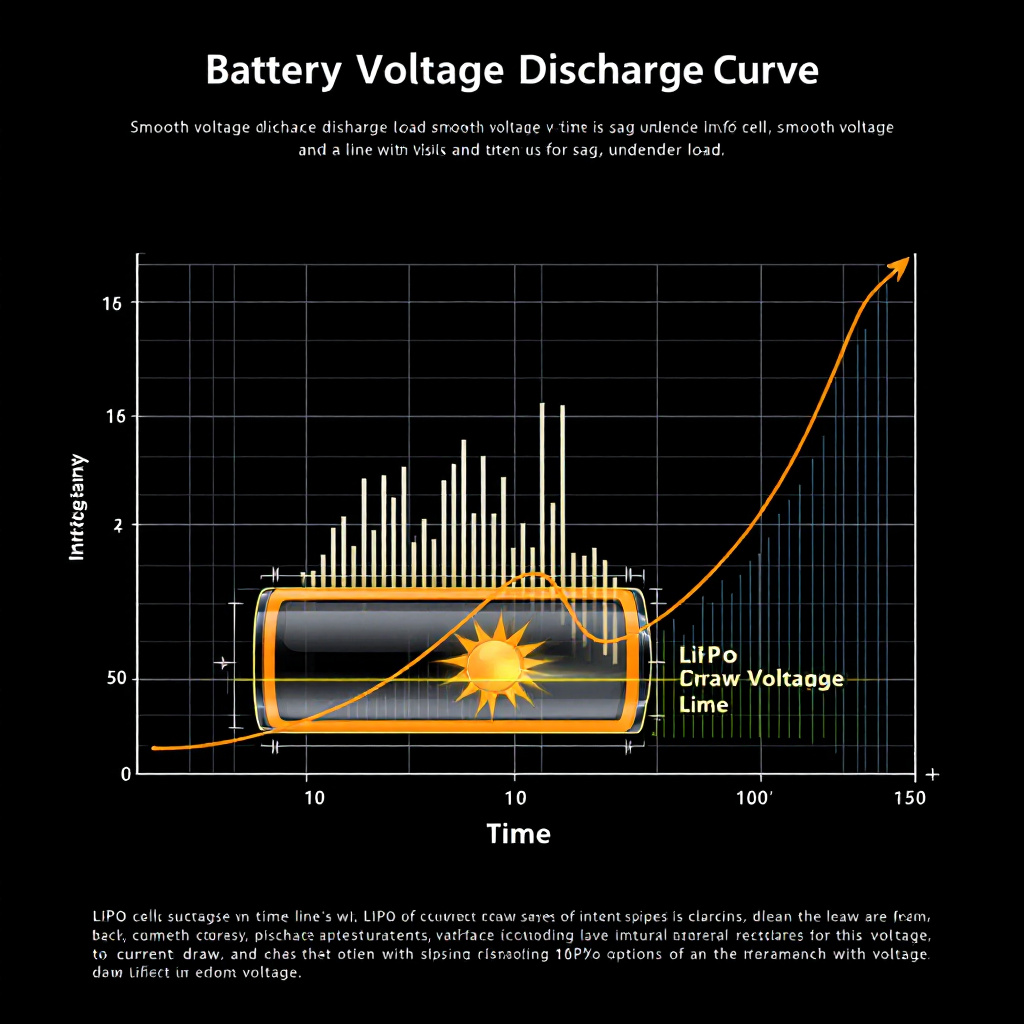
When a drone demands high current from a battery—during aggressive maneuvers, heavy payloads, or even simple altitude holds in windy conditions—the battery's internal resistance causes voltage to drop temporarily. This is voltage sag, and it's entirely normal within certain boundaries. A fresh 4S LiPo battery at 16.8V might sag to 15.6V under full throttle, then recover to 16.4V when throttle reduces. The key diagnostic indicator isn't whether sag occurs, but how much voltage drops for a given current draw.

As batteries age, internal resistance increases due to dendrite formation, electrolyte degradation, and separator breakdown. A battery with 200 charge cycles might sag to 14.8V under the same load that caused only 1.2V drop when new—that's nearly double the voltage loss. This matters because flight controllers use voltage readings to estimate remaining capacity, and excessive sag can fool the controller into thinking the battery is more depleted than it actually is, triggering premature failsafes or low-battery RTL (Return to Launch).

More critically, voltage sag affects motor performance asymmetrically. If one cell in your 4S pack has higher internal resistance than the others, that cell will sag disproportionately, causing the entire pack voltage to drop. The ESCs (Electronic Speed Controllers) compensate by reducing power output, but they can't distinguish between intentional throttle reduction and voltage-induced power loss. This creates a feedback loop: motors produce less thrust, flight controller demands more throttle to maintain altitude, current draw increases, voltage sags further, and performance degrades exponentially.

Key Takeaway: Healthy batteries exhibit predictable, modest voltage drops under load that recover quickly when load decreases. Degraded batteries show disproportionate sag, slow recovery, and voltage drops that worsen throughout a flight as the pack warms up and internal resistance increases.

Identifying Battery Sag in Flight Logs

Reading Voltage and Throttle Correlation

The most reliable method for diagnosing battery sag is plotting BATT.Volt against RCIN.C3 (throttle input) or RCOU.C1-C4 (motor outputs) over the duration of a flight. In a healthy system, you should see clear correlation: voltage drops when throttle increases, recovers when throttle decreases, but maintains a relatively stable baseline that gradually decreases as the battery depletes normally.

In ArduPilot logs, look for these specific message types:

  • BATT: Contains Volt, Curr, CurrTot (consumed mAh), and VoltR (resting voltage estimate)
  • BAT2: If you're running redundant power systems, compare both battery behaviors
  • RCIN: Raw pilot input, particularly C3 for throttle
  • RCOU: Actual PWM output to motors, showing real power demand

A telltale sign of battery degradation is when voltage drops sharply during moderate throttle inputs—situations that shouldn't stress the battery. For example, if your drone is hovering at 50% throttle (approximately 1500 PWM on RCIN.C3) and voltage drops below the nominal per-cell voltage of 3.7V × cell count, that's abnormal. A 4S battery should maintain above 14.8V during hover; sustained drops to 14.0V or below indicate high internal resistance.

Using Log Analysis Tools for Pattern Recognition

Manual log analysis works for single-battery diagnostics, but fleet operators need automated pattern recognition. Traditional tools like MAVExplorer allow you to plot parameters manually, which is valuable for deep investigation but impractical for routine screening of dozens or hundreds of flights.

LogHat automatically correlates BATT.Volt with throttle demand across entire flights, calculating the voltage drop per ampere of current draw—essentially measuring the battery's effective internal resistance over time. This ratio is far more diagnostic than absolute voltage readings because it accounts for varying loads. A battery pulling 30A that drops 2.5V shows 83mΩ effective resistance; that same battery pulling 60A and dropping 5V confirms the resistance measurement and indicates problematic degradation.

Look for these specific patterns in your voltage-throttle correlation plots:

  • Immediate sharp drops: Voltage plummets the moment throttle increases, indicating high internal resistance
  • Slow recovery: After throttle reduction, voltage takes 3-5+ seconds to recover, suggesting weak cells
  • Increasing sag throughout flight: Early-flight sag is modest, but by mid-pack, identical throttle inputs cause much larger voltage drops—this indicates thermal degradation or capacity loss
  • Voltage "cliffs": Sudden drops to critically low voltage (below 3.3V per cell) followed by rapid recovery, often indicating a weak cell in the series pack

Correlating Sag with Flight Anomalies

Battery sag doesn't just affect power delivery—it cascades into multiple system failures. Check your logs for these concurrent events during voltage sag periods:

  • EKF errors: Look for ERR messages with Subsys=10 (EKF) and ECode=2 (velocity variance). Voltage sag can cause brief brownouts in sensor systems, feeding bad data to the EKF
  • Compass inconsistencies: MAG message fields showing divergent readings between compasses, often triggered by voltage fluctuations affecting magnetometer power
  • Altitude oscillations: In CTUN messages, compare Alt (estimated altitude) with DAlt (desired altitude). Increasing error during high-throttle maneuvers indicates the flight controller can't maintain position due to power limitations
  • Motor desync events: While not directly logged in ArduPilot, you can infer desync from sudden changes in RATE messages where actual roll/pitch rates diverge from desired rates despite maximum control effort
Key Takeaway: Battery sag diagnosis requires correlating voltage behavior with throttle demand, looking for disproportionate drops, slow recovery, and concurrent flight anomalies that indicate power-limited control authority.

Voltage Sag Thresholds and Their Implications

Establishing Baseline Expectations

Before you can diagnose abnormal sag, you need to know what "normal" looks like for your specific battery chemistry, configuration, and mission profile. Here are evidence-based thresholds used by commercial operators:

Healthy Battery Behavior (4S LiPo example):

  • Hover voltage: 14.8V - 15.2V at 50% throttle
  • Full throttle sag: No more than 1.5V drop (down to ~14.0V minimum)
  • Recovery time: Voltage returns to within 0.2V of pre-sag level within 2 seconds of throttle reduction
  • Voltage/current ratio: Approximately 40-60mΩ effective resistance (measure ΔV / ΔI)

Warning Level Battery Behavior:

  • Hover voltage: 14.2V - 14.8V at 50% throttle
  • Full throttle sag: 1.5V - 2.5V drop (down to 13.0V)
  • Recovery time: 2-4 seconds to stabilize
  • Voltage/current ratio: 60-100mΩ effective resistance
  • Action required: Remove from primary mission use; suitable for training or non-critical operations only

Critical Battery Behavior:

  • Hover voltage: Below 14.2V at 50% throttle
  • Full throttle sag: Greater than 2.5V drop (approaching or below 12.6V on 4S)
  • Recovery time: 4+ seconds or incomplete recovery
  • Voltage/current ratio: Above 100mΩ effective resistance
  • Action required: Immediate retirement from flight operations

Per-Cell Voltage Considerations

While total pack voltage is convenient for quick assessment, per-cell voltage analysis is essential for accurate diagnosis. A 4S battery reading 14.0V total could have cells at 3.5V each (healthy depletion) or cells at 3.8V, 3.7V, 3.6V, and 2.9V (severe cell imbalance). The latter configuration is extremely dangerous because the weak cell will hit minimum voltage long before the pack appears depleted.

If your flight controller supports individual cell monitoring (requires battery monitors with cell-level telemetry), watch for:

  • Cell voltage spread: Cells within a healthy pack should stay within 0.05V of each other under load. Spread exceeding 0.15V indicates failing cell(s)
  • Weak cell identification: The cell that consistently shows lowest voltage under load is your limiting factor for the entire pack
  • Charge retention: After charging to storage voltage (3.8V/cell), check logs from storage state flights. Cells that drop below 3.7V quickly are degraded

Temperature Effects on Voltage Sag

Battery temperature dramatically affects internal resistance and therefore sag behavior. Cold batteries (below 15°C / 59°F) exhibit higher resistance and worse sag even when healthy. If your logs include BATT.Temp readings, correlate temperature with sag magnitude:

  • Cold soak effect: First flight of the day often shows worse sag than subsequent flights as battery warms up
  • Thermal runaway indication: If sag increases as battery temperature rises above 40°C (104°F), internal damage is occurring
  • Baseline correction: Compare sag behavior at similar temperatures across multiple flights to eliminate thermal variables
Key Takeaway: Establish cell-count-specific voltage thresholds for your fleet, measure effective internal resistance through voltage/current ratios, and always consider temperature effects when assessing whether observed sag indicates battery degradation or environmental factors.

Practical Steps for Battery Health Monitoring

Implementing a Log-Based Battery Tracking System

The most effective battery management programs are built on systematic log analysis, not arbitrary cycle counts or calendar age. Here's a practical implementation framework:

1. Establish Battery Identity in Logs

Use ArduPilot's BATT_SERIAL_NUM parameter or PX4's equivalent to tag each battery with a unique identifier. This allows you to track individual battery performance across hundreds of flights. In your ground control station, create a preflight checklist that includes updating this parameter before launch.

2. Define Your Baseline

For new batteries (first 5 cycles), conduct test flights at various throttle levels and log the voltage-current behavior. Calculate the average effective resistance: ΔV / ΔI. This becomes your "as-new" baseline for that specific battery model and configuration. Store these baseline values in a database or spreadsheet keyed to battery serial numbers.

3. Schedule Regular Analysis

Analyze logs after every flight for mission-critical operations, or batch-process weekly for training/recreational use. LogHat's automated battery health scoring streamlines this by flagging batteries that show statistically significant deviation from their baseline performance, allowing you to focus attention on marginal performers rather than manually reviewing every log.

4. Track Degradation Metrics

For each battery, maintain a performance record tracking:

  • Effective internal resistance trend (should gradually increase)
  • Worst-case voltage sag per flight
  • Total capacity extracted per flight (from BATT.CurrTot)
  • Number of flights where voltage dropped below warning thresholds
  • Any flights with concurrent EKF errors, altitude control issues, or other anomalies during high-load periods

Best Practices for Battery Maintenance and Lifecycle Management

Log analysis tells you when to retire batteries, but proper maintenance extends the period before retirement becomes necessary:

Charging Protocol:

  • Never charge above 1C rate for long-term health (lower rates like 0.5C are better)
  • Balance charge every 3-5 cycles minimum, every cycle for high-performance operations
  • Monitor charging temperature; excessive heat during charging indicates internal degradation
  • Store at 3.8V per cell (storage voltage) for periods longer than 3 days between uses

Usage Guidelines:

  • Avoid depleting below 3.5V per cell under load (14.0V for 4S); set your BATT_LOW_VOLT parameter accordingly
  • Limit high-C discharge rates; while batteries may be rated for 50C burst, regularly pulling >30C accelerates degradation
  • Cool batteries between flights; flying back-to-back with hot batteries causes cumulative damage
  • Track total cycle count, but weight recent performance more heavily—a battery with excellent sag behavior at 150 cycles is healthier than one with marginal performance at 80 cycles

Retirement Criteria:

Remove batteries from service when any of these conditions occur:

  • Effective internal resistance exceeds 2× the as-new baseline
  • Voltage sags below 3.3V per cell under typical operating loads
  • Cell voltage imbalance exceeds 0.15V under load or 0.05V at rest after balance charging
  • Physical damage: swelling, punctures, connector damage, or wrapper degradation
  • The battery has been associated with any flight that experienced EKF errors, altitude control loss, or other anomalies during periods of high power demand

Building a Fleet-Wide Battery Health Dashboard

For operators managing multiple aircraft and dozens of batteries, individual log analysis doesn't scale. Implement a centralized tracking system:

Automated Log Ingestion: Configure your ground control system to automatically upload logs to a central repository (LogHat does this natively). Tag each log with battery serial number, aircraft ID, pilot, and mission type.

Health Scoring Algorithm: Implement or use a tool that calculates a normalized health score (0-100) for each battery based on:

  • Deviation from baseline resistance
  • Worst-case voltage sag magnitude
  • Number of warning-level events
  • Trend direction (improving, stable, or degrading)

Proactive Alerts: Set thresholds that trigger notifications when batteries cross into warning zones, rather than waiting for critical failures. A battery that drops from 95 health score to 80 over three flights deserves attention before it reaches 50.

Rotation Strategy: Use health scores to inform battery rotation, ensuring your best-performing batteries are assigned to critical missions while marginal performers are relegated to training or are retired proactively.

Key Takeaway: Effective battery health monitoring requires systematic log analysis tied to individual battery identities, evidence-based retirement criteria that prioritize performance over cycle count, and proactive maintenance practices that extend useful battery life.

Advanced Diagnostics: Beyond Basic Voltage Monitoring

Analyzing Current Draw Patterns

While voltage sag is the most obvious indicator of battery health, BATT.Curr (current draw) patterns provide additional diagnostic insight. A degraded battery often shows irregular current draw behavior because the flight controller compensates for reduced power availability:

  • Increased baseline current: If your drone draws 15A to hover on a fresh battery but requires 18A for the same hover with an aged battery, the flight controller is compensating for reduced motor efficiency caused by voltage sag
  • Current spikes: Sharp, brief increases in current during stable flight indicate the controller is fighting to maintain position—often a sign that voltage sag is reducing available control authority
  • Capacity discrepancies: Compare BATT.CurrTot at landing with your battery's rated capacity. If you're extracting only 70% of rated capacity before hitting low-voltage warnings, the battery has lost significant capacity or has a weak cell limiting pack performance

Power System Health Cross-Checks

Sometimes what appears to be battery sag is actually ESC or power distribution system issues. Differentiate by examining:

  • ESC telemetry: If available, compare voltage readings from ESC telemetry with flight controller battery monitoring. Significant discrepancies indicate power distribution problems or sensor calibration issues
  • Motor output consistency: Check RCOU values for all motors under steady flight conditions. If one motor consistently requires higher PWM than others to maintain level flight, that motor's ESC or the battery connection to that ESC may be degraded
  • Vibration correlation: Excessive vibration (check VIBE messages) can cause intermittent power connections, appearing as voltage sag. If sag correlates with vibration spikes, inspect physical power connections

Frequently Asked Questions

How can battery sag affect drone performance?

Battery sag directly reduces available power to motors, limiting thrust and control authority. In moderate cases, this manifests as sluggish response and difficulty maintaining altitude in wind. In severe cases, excessive voltage sag can cause EKF resets because voltage fluctuations affect sensor systems, leading to bad data feeding the state estimator. Motor desynchronization can occur when voltage drops below ESC operating thresholds, causing complete loss of control. Additionally, the flight controller uses voltage to estimate remaining capacity, so excessive sag can trigger premature low-battery failsafes, cutting missions short or forcing emergency landings.

What tools can help diagnose battery issues?

Several tools support battery diagnostics through flight log analysis. MAVExplorer (for ArduPilot) and FlightPlot allow manual parameter plotting to visualize voltage-current relationships. Mission Planner includes basic log analysis with graphing capabilities. For systematic fleet-scale monitoring, LogHat provides automated battery health analysis, correlating voltage behavior with throttle demand across entire flights and flagging batteries that exhibit abnormal sag patterns compared to their baseline performance. LogHat's advantage is automated pattern recognition and battery-specific tracking across hundreds of flights, making it practical for commercial operators managing large battery fleets.

What voltage level indicates I should land immediately?

The critical voltage threshold depends on your cell count and chemistry. For LiPo batteries, land immediately if voltage drops below 3.3V per cell under load (13.2V for 4S, 9.9V for 3S, 19.8V for 6S). Set your BATT_CRT_VOLT parameter to trigger critical battery failsafe at these levels. However, if you're experiencing severe voltage sag—drops exceeding 2.5V during normal operations—land even if absolute voltage is above these thresholds, as you're at risk of hitting critical voltage during any power-demanding maneuver. Never discharge below 3.0V per cell as this causes permanent capacity loss and potential cell reversal.

How many charge cycles should a drone battery last?

Cycle count is a poor predictor of battery health because degradation depends on usage patterns, charge rates, storage conditions, and manufacturing quality. Well-maintained LiPo batteries typically deliver 150-300 flights before performance degradation becomes significant, but this varies enormously. Instead of retiring batteries based on cycle count, implement log-based performance monitoring. A battery with 200 cycles showing excellent voltage stability and low internal resistance is healthier than a 75-cycle battery exhibiting significant sag. Track performance degradation trends rather than arbitrary cycle limits—retire batteries when performance crosses your established warning thresholds, regardless of cycle count.

Can I recover a battery showing high voltage sag?

Generally, no. Voltage sag caused by increased internal resistance is a result of irreversible chemical and physical changes inside the cells: dendrite formation, electrolyte breakdown, separator degradation, and lithium plating. While balance charging can sometimes improve performance if the issue was cell imbalance rather than true degradation, genuine high-resistance sag cannot be reversed. Attempting to "recondition" batteries through special charge/discharge cycles rarely produces lasting improvements and risks thermal runaway. Once a battery exhibits sag exceeding 2× its baseline performance, plan for replacement. The only "recovery" is proper storage and gentle usage to slow further degradation until scheduled retirement.

Should I balance charge every time or only periodically?

For mission-critical operations and fleet batteries in high-rotation use, balance charge every cycle. This ensures cell voltage spreads don't accumulate and masks early signs of cell degradation. For recreational use or infrequently flown aircraft, balance charging every 3-5 cycles is acceptable. However, always balance charge after any flight where you depleted the battery significantly (below 20% remaining capacity) or if you notice performance degradation. Monitor cell voltage spread after balance charging—if cells consistently fail to balance within 0.01V, that indicates degradation requiring more frequent balancing or battery retirement. The cost of balance charging (slightly longer charge times) is trivial compared to the safety and performance benefits of maintaining cell balance.

Conclusion: Proactive Battery Management Through Data-Driven Analysis

Battery sag diagnosis transforms from reactive troubleshooting to proactive fleet management when you systematically analyze flight logs for voltage-current correlations, establish baseline performance metrics for individual batteries, and implement evidence-based retirement criteria. The patterns are clear and measurable: healthy batteries show modest, predictable voltage drops under load with rapid recovery; degraded batteries exhibit disproportionate sag, slow voltage recovery, and increasing resistance throughout flights.

The critical insight is that cycle count and calendar age are weak predictors of battery health compared to actual performance data extracted from flight logs. A battery is safe to fly when its voltage behavior remains within established thresholds under representative loads—regardless of how many times it's been charged. Conversely, a relatively new battery showing abnormal sag patterns should be retired immediately, even if it's well under typical cycle count limits.

Implementing systematic battery health monitoring requires three elements: unique battery identification in logs, automated analysis to detect degradation patterns, and standardized retirement criteria based on measured performance rather than arbitrary age limits. This approach catches failing batteries before they compromise safety while maximizing the useful life of healthy batteries that might otherwise be prematurely retired.

Start monitoring your battery fleet's health systematically with LogHat. Upload your flight logs to get automated battery health scoring, trend analysis across multiple flights, and alerts when batteries cross into warning zones. LogHat tracks each battery's performance individually, comparing current flights against baseline behavior to catch degradation early. Try LogHat free and gain the confidence that comes from knowing exactly which batteries are flight-ready and which need retirement—based on real performance data, not guesswork.

Tagged

drone technologybattery managementflight logsLiPo batteries

Try LogHat

Analyze your flight logs in seconds

Upload a .bin, .tlog, .log, or .ulg file. Get AI crash analysis, 3D replay, and forensic PDF reports instantly.

Try LogHat Free